Tuesday, July 15, 2008

Beware of Cable Guys Making Promises

Comcast can't seem to get it straight.

On the one hand, the cable giant blocks access to certain Web applications. On the other, Comcast executives extol the virtues of a "free market" to safeguard against any abuse of users' right to choose online.

So which is it?

What the cable giant really wants is to thwart any policies that would stop it from doing whatever it pleases. And at this moment the company wants to play gatekeeper -- "managing" its network in a way that prevents users from gaining access to the Open Internet.

Of course, Comcast's executives will never admit this. But their true intentions lurk in the fine print of statements and filings they have made at the Federal Communications Commission over the years.

These filings reveal a familiar pattern. The company uses free-market rhetoric and pledges of good corporate citizenship to exact favorable rule changes from the federal agency. Once those rulings are in place, it does an about face -- breaking promises and creeping further towards throttling our Web experience and dominating the access market.

As the FCC weighs how to sanction the company for blocking access to applications like BitTorrent, it's worth looking into Comcast's Washington history of bait and switch.

A little digging through FCC's archives tells the tale.

Exhibit A: Open Access

Back in early 2002 Comcast was engaged in the debate over whether cable companies should share “their pipes” with competing Internet service providers. Such "open access" requirements were the law during the age of dial-up Internet, resulting in dozens of competing ISPs delivering services via a single phone line into the home.

Free Market Do Do Birds

Casserly: Friend to Open Access?

Comcast was set against open access rules being extended to cable Internet and deployed legions of lobbyists in Washington to fight the notion. But when they worried their purchase of (the old) AT&T’s broadband service might be derailed, they pledged to offer open access to competing services.

In an "ex parte" letter filed at the Commission in February of that year, Comcast's attorney James L. Casserly touted this promise as:
Concrete evidence of Comcast's intention to afford high-speed Internet customers a choice of ISPs and of the ability of industry participants to make the necessary arrangements through voluntary, commercial negotiations
.
In a subsequent filing Comcast promised that the merged entity "will have a significant incentive to continue to work with independent ISPs." And in another filing still, the company pledged: "Comcast is committed to negotiating mutually beneficial commercial arrangements with independent ISPs."

Comcast coupled these filings with press releases heralding the company’s partnership with independent ISPs like NetZero, Juno and Earthlink (remember them?) as a sign of their commitment to open access.

Comcast Changes its Tune

So what happened? Based upon Comcast's promises of good behavior, the Commission exempted cable companies from open access rules – opening the door to the court decision and subsequent FCC rulings that put Net Neutrality in jeopardy.

Waz

Waz: The Old Bait and Switch

On the heels of the FCC decision against open access, Comcast did a 180. In October 2003, the Washington Post reported that "Comcast officials say they are no longer so keen on the idea" of agreeing to provide access to other services. Joe Waz, a Comcast vice president, added: "If you don't need ISPs for basic connectivity to the Internet, what value do they bring to our customers?"

In other words, as soon as Comcast execs got what they wanted from the FCC, the promises to share their wires at a fair price were forgotten. The press releases touting their deals with competing provider weren’t worth the paper on which they were written.

The end result is that, today, a Comcast customer has no other choice but Comcast for Internet service via their exclusive cable connection. They're stuck with one option, and the "free market" – little more than a chimera in America's high speed Internet world -- had nothing to do with it.

Exhibit B: The Open Internet

Fast forward to 2008. Comcast is now making promises to work with competing video and Internet telephony services and stop blocking popular file-sharing applications. They insist there’s no need for FCC oversight to protect our right to use services of our choice every time we connect to the Web.

Free Market Do Do Birds

Cohen: Free Market Wise Guy

Washington should "rely on the marketplace rather than government regulation to advance the provision of Internet services," wrote Comcast Executive Vice President David Cohen in a March filing with the agency. Cohen points to a press release -- issued jointly by BitTorrent, Inc. and Comcast -- as evidence of the "fundamental wisdom of this approach."

In a July filing with the Commission, Vice President Kathryn Zachem pledges Comcast's commitment "to provide network management solutions that benefit consumers and competition."

If past is prologue, why should we expect things to be any different?

Trust the Profit Motive Only

The Comcast message, in case you’ve missed it, sounds like this: "With the free market, we can solve our own problems and deliver to end users the Internet experience that they desire. Trust us."

"A company has a nature," Professor Larry Lessig said earlier this year. "Its nature is to produce economic values and wealth for its shareholders." That one essential truth is about as much trust that we need to extend to corporations, Lessig adds.

Public policy, on the other hand, is designed to make it profitable for corporations to behave in ways that serve the public interest.

With Chairman Martin's latest move to hold the cable company accountable, it seems some at the federal agency have learned this valuable lesson.

Friday, July 11, 2008

Internet Users Stop Comcast, Net Neutrality Win on the Horizon

Federal Communications Commission Chairman Kevin Martin is taking action against Comcast for illegally violating Net Neutrality, after a coalition of Net users and activists caught the cable giant blocking open access to the Internet.

Martin told the Associated Press last night that Comcast had "arbitrarily" blocked Internet access and failed to disclose to consumers what it was doing. "We found that Comcast's actions in this instance violated our principles."

Topolski Ignites the Fire

The move is the agency's response to a complaint filed by Free Press and members of SavetheInternet.com, which called for severe action against Comcast for jamming people using popular "file-sharing" applications. But the story goes back further than that.

Organized People Beat Organized Money

Martin's action -- to be voted on by the full FCC in three weeks - would be a major milestone for the growing open Internet movement, marking another defeat of entrenched corporate interests in Washington and a stunning victory for ordinary people who want to control their Internet experience.

If adopted by the FCC, Martin's order could set an historic precedent for protecting the future of the open Internet. Against every ounce of conventional wisdom in Washington, everyday citizens and consumer advocates have taken on a major corporation and won a major victory.

The decision follows nearly a year of organizing and action by a growing alliance of bloggers, Internet innovators, consumer groups, organizations from across the political spectrum, and Net activists from all walks of life.

In that time, tens of thousands of people wrote the FCC in support of Net Neutrality after Free Press filed its complaint against Comcast and asked the agency to levy the largest fine in its history.

Comcast's "Shame"

Hundreds of others packed public hearings to speak out against would-be gatekeepers (even after Comcast notoriously attempted to keep them out by hiring drowsy seat warmers in Boston).

The Power of One

But it all started with one person. When barbershop quartet enthusiast Robb Topolski found Comcast was preventing him from sharing legal music files with other fans, he took to his computer and launched a one-man investigation.

Topolski uncovered conclusive evidence that Comcast was secretly blocking his uploads. His concerns echoed those of hundreds of other Comcast users, who had taken to the blogs and chat rooms to express their dismay.

He posted his findings on a single tech blog. This had a cascading effect, and soon dozens of others were writing about his findings. The Associated Press and the Electronic Frontier Foundation conducted their own investigations with similar results. The evidence was indisputable: Comcast was blocking the Internet.

The wheels of government started churning. This time for the better.

The Fight Continues

Martin's move is a major victory. But this fight is far from over. His order has yet to pass, though it seems likely. The cable companies -- and the phone companies, too, even though they're trying to distance themselves from Comcast -- will be back with their money, lawyers and phony grassroots groups to try to take control of the Internet and establish themselves as gatekeepers.

Companies like Comcast, AT&T and Verizon are spending hundreds of millions of dollars to lobby Washington to gut Net Neutrality and hand over control of the Internet to them. But they so far have failed to overcome widespread and organized public opposition.

Today we can celebrate a huge victory for real people, but we need to continue this fight to send a clear signal to the next Congress and White House that standing with regular people for a free and open Internet is a winning proposition.

America's Next Moon Shot: Internet for Everyone

Almost every great public initiative in America's history, the electrification of rural communities, the creation of the interstate highway system or the 60s-era mission to the moon, started with a powerful vision and the political leadership to get it done.

We need both as we face a challenge to reawaken our democracy and drive economic growth in a world where America's greatest commodity is its people.

This challenge, of course, is delivering high-speed Internet access to everyone.

Internet luminaries speak out for Internet for everyone

And it's no small lift as we have already dug ourselves a hole. Access to broadband today is held in the grip of the cable and phone cartel. This duopoly controls access for more than 98 percent of online American homes. And it's the main reason why American pay far more for much slower speeds than what's available in the rest of the developed world.

Sharing the Broadband Dividend

It has put us at a tremendous disadvantage - one that has been widely documented. But what's alarming is new information about the demographics of access - the so-called "digital divide." According to new analysis by Free Press (my employer), only 35 percent of U.S. homes with less than $50,000 in annual income have a high-speed Internet connection.

And the broadband dividend is not paying out equally. Only 40 percent of racial and ethnic minority households in the United States have access to broadband, while 55 percent of non-Hispanic white households are connected.

"The digital divide is alive and well," Van Jones, the founder of Green For All, said during yesterday's launch of InternetforEveryone.org - a new initiative to solve America's gaping broadband access problems. "There's a whole section of people who have not even caught up to where we are now and are in grave danger of being left behind."

According to Jones, this has dire consequences for one's ability to vote, to be a part of the economy and, even, to survive - he mentioned the deaths of migrant farm workers, who didn't receive Web-based emergency notices in time to escape last year's wildfires in California.

Like Hot Water

"Why Internet for all? I think Internet access is required for full participation in society today. Maybe it's not as basic as water, but it's definitely as basic as hot water," Robin Chase, the founder of Zipcar, said.

According to Chase, Internet access is fundamental to maintaining a high quality of life and for addressing such pressing social problems as America's energy dependency.

Getting Beyond Rhetoric

Returning to the top of international rankings would translate into millions of new jobs and hundreds of billions of dollars in increased economic activity for the United States.

For good reason, other developed countries have enacted comprehensive national plans to connect more of their citizens to a fast, affordable and open Internet. The U.S. doesn't have a plan or the leadership to get it done.

We do have national broadband rhetoric, though. In 2004, President Bush pledged "to have a universal, affordable access for broadband technology by the year 2007."

As if on cue, last year, Mr. Bush's chief Internet officer, John Kneuer, declared "mission accomplished" -- that all the international surveys were misleading and that the "free market" had ensured that Americans across the country enjoy real choice in high-speed Internet access.

What he and his White House compatriots refuse to acknowledge, though, is that a free market approach for Internet services in the U.S. is a chimera. The only hand in play here belongs to the phone and cable duopoly and a government that's been held in their thrall for too long.

The real solution is a little more nuanced.

Neanderthals and the Three Legged Stool

During the launch of InternetforEveryone.org, FCC Commissioner Jonathan Adelstein described himself as a "frustrated policymaker" in Washington. "At the FCC I have a stack of proposals on my desk about a national broadband policy," he said. "What we're lacking is the leadership to actually implement those policies."

Adelstein looks at a successful broadband plan as a three-legged stool:

"You have businesses, who will invest and drive deployment, you have the government on all levels hopefully working in concert, and then you have the public both directly involved and through public interest groups like this coalition."

"This is social infrastructure," Professor Larry Lessig said:
"What's bizarre about where we are in the history of building infrastructure is that this is the first time we have tried to undertake the building of fundamental social infrastructure against the background of a Neanderthal philosophy, which is that you don't need government to do anything.

"That Neanderthal philosophy has governed for about the last eight years, and it has allowed us to slide from a leader in this field to an abysmal position. And it's about time when people recognize that of course the private sector has a role, a central role, maybe the most important role, but it's never enough.


Making it Happen

InternetforEveryone.org is bringing together public interest and for-profit institutions to raise public awareness of the digital divide and spark the political will to address this massive problem.

Closing the broadband digital divide should have been a real national priority for the past eight years. We can't afford NOT to make it a priority for the next eight. While our status as world technology leader went into free fall, Congress sat on the sidelines and the White House ducked and dodged.

There's a reason for that. Getting everyone connected is a political issue at its core. The policy process has been dominated thus far by the broadband incumbents and their well-heeled lobbyists. These companies prefer our lagging Internet status quo to public involvement, choice and real innovation.

And the community that uses the Internet is only now beginning to get organized to guide the debates that will shape its future. We clearly need to do more organizing with the tens of millions of people in communities that can't access the Web.

Getting us back on top will require a national broadband framework that is supported by those beyond the Beltway - who stand to gain the most from a national broadband agenda that promotes access, choice, openness and innovation. And we need bold leadership willing to reject the conventional political wisdom and explore real solutions.

Tuesday, June 03, 2008

The Cure for America's Internet

You can see them parked outside of libraries and coffee shops in towns scattered across the hills of Western Massachusetts. They're identified by the blue glow emitting from inside their cars.

Across the state, 95 towns have limited or no access to high-speed Internet. People in Massachusetts' more rural western half have had to resort to a game of Internet hide and seek -- searching out wireless hotspots, laptops plugged into car lighters and nestled in their laps.

Road to Nowhere

Building the Net Superhighway

Maureen Mullaney of Ashfield, Massachusetts, lives in one of these under-served towns. She seeks out these roadside hotspots so her children can do research for school projects. "How silly is it that in this day and age you have to get in your car, drive to the general store so your daughter can researchers the rivers and traditional clothing of Chile?" she asks.

"Even if every person in my town is screaming out loud for high-speed Internet that would still just be 1,800 people."

But Maureen and her neighbors are not alone. While a generation of Americans can barely remember life without a Google search at our fingertips, millions of households still can't send an e-mail, let alone pay bills online, check the weather or conduct research for school.

A Broadband Backwater

The shortcomings of the U.S. broadband market are tremendous - more than 10 million U.S. households remain un-served, while nearly 50 million homes are priced out of subscribing to broadband services - and the social and economic consequences are dire.

Late last month, yet another global survey confirmed this, showing the U.S. to be more of an Internet backwater than a world leader. According to the Organization for Economic Cooperation and Development (OECD), Internet access and services in America have slid to 15th place among 30 developed nations, a drop from our 12th place ranking in 2006, and from fourth in 2001 when the OECD began its international survey.

In real terms this means Internet users in Japan pay little more than half the price (65 cents to the dollar) for an Internet connection that's 20 times faster than what's commonly available to people in the United States.

Yet people in the U.S. are still stuck off the grid, or with unreliable and slow dial-up, with little relief in sight.

A Man, No Plan, The Internet

The reasons for America's digital decline are many. But first is this: Other developed countries have enacted comprehensive national plans to connect more of their citizens to a fast, affordable and open Internet. The U.S. stands alone among OECD countries without a national broadband program.

We do have national broadband rhetoric, though -- and an army of well-heeled apologists to trumpet "successes" and gloss over problems. And the damage is now beginning to show.

In 2004, President Bush pledged "to have a universal, affordable access for broadband technology by the year 2007."

As if on cue, last year, Mr. Bush's chief Internet officer John Kneuer declared "Mission Accomplished" -- that all the international surveys were misleading and that the "free market" had ensured that Americans across the country enjoy real choice in high-speed internet access.

The Hand of the Duopoly

Kneuer's Pontius Pilate approach is now familiar to the Bush administration -- America's problems will disappear with a wave of the magical hand of the free market.

What he and his White House compatriots refuse to acknowledge, though, is that a free market approach for Internet services in the U.S. is a chimera. The only hand in play here belongs to the phone and cable duopoly, which controls broadband access for more than 98 percent of homes.

The net effect of this duopoly is a dearth or real choices; allowing providers like AT&T and Comcast to exact high prices from Internet users, while delivering connections that are too slow -- and, often in the case of cable, too congested - to meet growing demand.

The market imbalance is beginning to take its toll. A Brookings Institution study counts 300,000 new American jobs each year for every 1 percent increase in broadband adoption.

Larry Page, Google's co-founder and president, put it a different way. "We're pretty far behind and for us it's a big problem because we have our main headquarters in the U.S. and our employees have only a one megabit service," he told me during his recent visit to Washington.

"If we're thinking about building the next generation of Internet services they're not going to be on one megabit services, they're going to be 100 megabit services and we're not going to end up developing those... In terms of the U.S. being competitive, it's very important for us to be leading that rather than following. And we show no signs of being able to do that."

Free Market Mumbo Jumbo

Our inability to truly wire the nation is itself the result of poor policy decisions. For decades, U.S. communications legislation has been held captive by lobbyists working for--you guessed it-- the phone and cable companies.

These Internet service providers are among the most prolific spenders in Washington. They spend hundreds of millions of dollars on lobbyists, campaign contributions, P.R. firms and paid junkets to help ensure that special rules are written in their favor.

For all their talk about the free market, the cable and telephone giants work aggressively to force through regulations that protect their market duopoly, close the door to new market entrants and competitive technologies, and increase their control over the content that travels across the Web

Japan Pries Open Its Market

In 2000, Japan faced a similar dilemma -- an Internet industry stifled by the heavy hand of a few network gatekeepers. But the government responded by pulling together the nation's leaders from the pubic and private sector to launch an "e-Japan strategy" aimed at connecting 40 million of Japan's 46 million households within five years.

The Japanese government quickly moved to create a highly competitive private sector by compelling regional telephone companies to open their residential lines to wholesale access by other competitors. They also adopted policies to prevent the type of online discrimination that has reared its head recently in the U.S.

In 2001, Japan counted only 2.2 broadband subscribers per 100 inhabitants. By mid-2004, ultra-high-speed broadband connections were available to more than 80 percent of Japan's citizens. By 2006, Japan declared that it had surpassed the broadband goals of e-Japan and was ready to launch its next national strategy, called "u-Japan". The "u" takes the nation's broadband beyond "ubiquitous," to become "universal," "user-oriented," and "unique."

Getting Behind a Big American Idea

Free Press' own research found that most of the countries with similar universal and open access policies had nearly twice the level of broadband penetration as those that did not.

The OECD seems to agree. "Governments providing money to fund broadband rollouts should avoid creating new monopolies," according to its report summary. They recommended that any public broadband infrastructure "should be open access, meaning that access to that network is provided on non-discriminatory terms to other market participants."

Public policy should be designed to make it profitable for corporations to behave in ways that better serve both the free market and the public interest. And we're seeing more and more from international examples that that requires a shared vision with a light but clear legislative touch. (This issue will be widely discussed this coming weekend as Internet activists, visionaries and innovators come together in Minneapolis at the National Conference for Media Reform).

When President Eisenhower set Americans to work building the nations' Interstate Highway System he mobilized members of Congress from both sides of the aisle to appropriate federal funds and create corporate incentives for the construction of 41,000 miles of new roads. It was the largest infrastructure project in American history to that point, but the $25 billion in federal money set aside to build the nations main arteries yielded an almost immediate return to our nation's economy.

The construction of a universally accessible Internet superhighway ranks as important today, and it can be accomplished with even stronger collaboration between the public and private sector.

Future policymakers who are serious about America's well-being should learn from our failings and from success in other countries so we can deliver the vast benefits of an open connection to every American. It's time we started construction.

(photo Courtesy of Pete and Genevieve on Flickr)

Saturday, May 31, 2008

McClellan and the 'Enablers'

For all the press attention swirling around Scott McClellan's explosive tell-all, there's a brewing back story that's making Katie Couric and Charles Gibson squirm. And they're not alone.

Few were surprised that McClellan's book exposed a Bush administration "political propaganda campaign" that mislead the American public about the war in Iraq. Some question the former press secretary's loyalty and timing, but no one -- with the obvious exception of the White House and its apologists -- questions the factual basis of his claim.

But McClellan takes it one further, implicating mainstream media for its role in "enabling" this propaganda. "The national press corps was probably too deferential to the White House" in spreading the president's case for the war, McClellan writes. The mainstream media didn't live up to its watchdog reputation. "If it had, the country would have been better served."

This should be a shock to everyone. The president's own spokesman (whose hands aren't clean by any means) lays a large share of the blame for Bush's pro-war propaganda on the media's "deferential" treatment of White House spin.

Still, many in the media refuse to admit that they were anything but dogged in challenging the White House's case for the war after September 11. Some, however, are starting to see things differently.

Pro-War Pressure from Execs

Media Culpa?

Thursday night, CBS anchor Katie Couric confronted McClellan' during an interview. She claimed that, while still at NBC, she asked a tough question about the Iraq war and was rebuffed by McClellan. According to Couric, the press secretary then called one of her bosses and threatened to deny her future access to the White House press gaggle.

But earlier Couric told her colleagues on the CBS News Early Show that McClellan's indictment of a complicit media is "a very legitimate allegation."

"I think it's one of the most embarrassing chapters in American journalism," she said. "And I think there was a sense of pressure from corporations who own where we work and from the government itself to really squash any kind of dissent or any kind of questioning of it. I think it was extremely subtle but very, very effective."

On Wednesday night, CNN correspondent Jessica Yellin said that network executives at MSNBC had pushed her not to do hard-hitting pieces on the Bush administration as the nation readied for war.

"The press corps was under enormous pressure from corporate executives, frankly, to make sure that this was a war presented in a way that was consistent with the patriotic fever in the nation," Yellin told CNN's Anderson Cooper.

ABC News' Charles Gibson isn't admitting as much. "I think that the media did a pretty good job of focusing and asking the questions," he said. "It was just a drum beat from the government, and I think it's convenient now to blame the media, but I don't," he added. (This from the same anchor who called his questioning during ABC's now infamous April 16 debate "tough and intelligent").

It's the System, Stupid

It's telling that mainstream journalists are in a quandary over the role their media organizations played to "enable" propaganda, and whether they individually are indeed a part of the problem. Many genuinely are trying to do their jobs but are constrained by a corporate structure that promotes reporters with cozy access to political and economic power, while discouraging those whose questions and investigative reporting might rock the boat.

The roots of the problem extend beyond the performance of one or another reporter to a news industry that allows itself to be manipulated and cajoled by dishonest leadership. "Too many media outlets continue to tell the politically and economically powerful, 'Lie to me!'" write Bob McChesney and John Nichols in a Nation op-ed to be published next week.

According to McChesney and Nichols, responsible journalists have little say in setting the lead stories for large outlets. "The calls are being made by consultants and bean counters, who increasingly rely on official sources and talking-head pundits rather than news-gathering or serious debate."

The Situation Right Now

For all of their posturing, the Courics and Gibsons of the network newscasts are the fading faces of a system that's perilously broken. It's not just reflected in the declining audience for traditional news formats, but in the issues that they cover -- and those that they choose to ignore.

This gathering problem can no longer be shrugged off by prominent members of the media.

McClellan's memoir comes on the heels of an April 20 New York Times exposé, which revealed an extensive -- and likely illegal -- Pentagon program to recruit pro-war "military analysts" for nearly every major news outlet in America. Many in the newsrooms knew of these pundits' ties to the Pentagon -- as well as their involvement in lucrative military contracts -- but didn't bother to reveal the obvious conflicts of interest to their viewers.

While the story received scant coverage in the mainstream media, more than 100,000 activists have written their members of Congress to urge an investigation into the media's role in spreading pro-war propaganda. Bloggers and independent media are also still covering this issue, refusing to let Big Media off the hook

Congress has promised to investigate the Pentagon's role in the scandal, but it shouldn't end there. People should demand more of the companies that assume the mantle of journalism, but fall far short of its ideals.

Our democracy is in peril when mainstream media fail to question the official view and put the interests of ordinary Americans first.

This watchdog role is especially critical during a time of war and elections -- the time that we're in right now.

Monday, May 19, 2008

A House Divided, United or Just Confused

ComcastSleepers

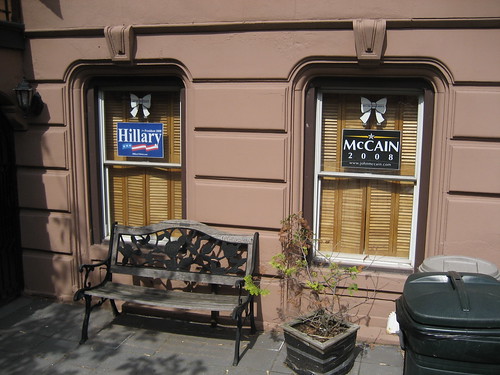
I've been wanting to test Vizu's free polling tool. Yesterday I found my first question when I came across this Hoboken brownstone. It got me wondering whether this was more than just one house divided -- that perhaps there was another message behind the posters. (Click here to see an enlarged version)

Take the poll below, add your comments to the thread, tell me what you think.

Friday, May 16, 2008

Free Speech in the 21st Century

Freedom of the press extends only to those who own one -- or so the saying goes. It once rang true in a world ruled by newspaper chains, radio and television broadcasters, and cable networks.

But the Internet has changed all that, delivering the press -- and in theory its freedoms -- to any person with a good idea and a connection to the Web.

Backyard Auteurs

This extraordinary twist to "mass media" has catapulted many an everyday YouTube auteur to celebrity-status while turning ideas born in a garage or dorm room into Fortune 500 companies. It is the reason so many Americans are now passionate about protecting their right to choose on the Internet. But it's also triggered a backlash from the old regime -- media corporations that built their empires upon controlling the ebb and flow of information in America.

This list of media giants includes the nation's largest phone and cable providers, who provide a portal to the high-speed Internet for more than 98 percent of residential users in America. Now they want to be more than just a window to the Web. These companies have proposed a closed scheme of Internet fees and filters that affords them the final say over which ideas make it to the top of the heap.

Say "goodbye" to indy rock bands breaking big via a backyard YouTube video and "hello" to censored rock-and-roll courtesy of AT&T's "Blue Room."

Open v. Closed -- A Clash of Cultures

This closed business model has proven a financial windfall for the gatekeepers of traditional media. But it comes at a too heavy a cost to the millions of Americans who see the open Internet as the 21st Century's catalyst for free speech and opportunity.

It's against the backdrop of this clash of cultures -- open versus closed -- that an unusual series of official events have occurred this year.

Washington -- where lobbyists for Comcast, AT&T and Verizon have long had the home-field advantage -- recently witnessed an extraordinary series of public meetings and congressional hearings on the fate of the Internet. If you listen carefully, you might actually hear the people's interests being represented. They are certainly being expressed.

The 110th Congress has called Sir Tim Berners-Lee, the inventor of the World Wide Web, and Chad Hurley, the founder of YouTube, to testify in favor of Net Neutrality -- the principle that safeguards the Internet against blocking and censorship from Internet service providers. In recent weeks, leading consumer and Internet rights advocates, Silicon Valley's top entrepreneurs and Hollywood's creative community have testified that an open Internet is vital to the health of our economy and democracy.

The Federal Communications Commission has gone one further, venturing beyond the Beltway to take the public temperature on the Internet.

At hearings in Cambridge, Mass., and Palo Alto, Calif., the agency got an earful; hundreds of Net Neutrality supporters stood before the microphone to condemn Comcast's recent efforts to block people from using peer-to-peer applications, which make possible the sharing of videos and other rich media without the need for corporate media to broker the content. One after the other. people called on the federal agency for basic protections against Comcast's brand of digital discrimination.

The New Free Speech Movement

They are not alone. A growing movement of Internet users is pushing for legislation to stop would-be gatekeepers from re-routing the free-flowing Web. It has attracted millions of supporters ranging from MoveOn.org to the Christian Coalition of America, from independent rockers OK Go to the executive producer of the TV show "Hannah Montana."

Our voices are starting to rise above the din of lobbyists that too often drowns out genuine public debate in Washington. It's now up to our elected officials to act.

The official inquiry on Net Neutrality has given a public voice to the remarkable consensus in favor of free speech and user choice on the Web. And it may turn out to be more than show. The bipartisan "Internet Freedom Preservation Act" is making its way through the House at this very moment. It is a bill that takes into account the many voices that have spoken out since Net Neutrality became a much-debated principle.

Fundamentally, this bill recognizes that we must establish baseline protection for an unfettered Internet. It doesn't call for Web regulation, but gives the public the power to stop the old regime from turning the Internet from a revolution of the many into a funnel for the few.

And that's a freedom worth fighting for.

Tuesday, April 22, 2008

Comcast's 'Bill of Rights,' Wrong for an Open Internet

Comcast can't seem to get it straight.

On the one hand they're snubbing a debate over openness and the Internet -- refusing to take part in yesterday's FCC public hearing. On the other, they've announced plans to open an industry-wide conversation to craft a "bill of rights" for ISPs, Internet companies and users.

The latter, a Comcast collaboration with Internet traffic managing company Pando Networks, received mixed reviews earlier this week when the cable company rolled it before the media.

I trashed it. And now my initial concerns seem justified.

The Right to Special Treatment

For just as the public hearings were getting underway in Stanford, Robert Levitan, Pando chief executive, told the New York Times that "he hoped Comcast might program its network to give preference to applications like the one his company makes."

Levitan's admission exposes the true motives behind industry efforts to craft a "bill of rights:" to lay the ground for an Internet rife with discriminatory deals and preferential treatment.

"The company appears to want to use the network management issues raised by Comcast to seek a deal that provides them preferential distribution over the Internet," Markham Erickson, executive director of the Open Internet Coalition, said in a statement.

"It is exactly why technology companies, innovators, and millions of consumers have argued that the marketplace is not working properly and have asked the FCC provide basic rules of the road to protect against such behavior."

The Right to Ignore the Rules

The industry's carefully orchestrated announcements of initiatives to self-regulate are not the magic of the free market at work, Free Press policy director Ben Scott testified yesterday. "It is the threat of regulatory intervention."

Without that threat -- and an agency willing to act on behalf of the public interest -- we'd have already sacrificed several basic Internet freedoms to the whims of Pando and Comcast.

"Comcast actions to date have shown that they can't be trusted to 'self regulate,'" L. Peter Deutsch, a pioneering Xerox Palo Alto Research Center computer scientist, told the FCC. "Allowing the big carriers rather than consumers and public interest advocates, to take the lead in codifying a 'bill of rights' for Internet users would be like letting King George's cabinet take the lead in writing the U.S. Constitution."

Comcast had hoped that we would all interpret the "bill of rights" as a genuine -- to conclude that public hearings and FCC oversight were not needed to keep the Internet open for everyone.

The Right to Undermine the Internet

The Comcast message, in case you've missed it, sounds like this: "The free market can solve its own problems and deliver to end users the Internet experience that they desire. Trust us."

"A tiger has a nature, and that nature is not one you trust with your child," Professor Larry Lessig said during yesterday's Stanford hearing. "A company has a nature. It's nature is to produce economic values and wealth for its share holders."

According to Lessig, that one essential truth is about as much trust that the public needs to extend to public corporations. It's understood that they will behave in this way, and nothing is wrong with that.

Public policy, on the other hand, is designed to make it profitable for corporations to behave in ways that serve the public interest.

According to Lessig: "We set public policy to create the incentives for them to pick the right business models."

In a perfect scenario we also set public policy to foster more a productive and economically beneficial marketplace for all involved. Net Neutrality is such a policy.

Thursday, April 10, 2008

Stanford Hearing an Internet Wake-Up Call

Get ready for Round Two in the Internet's Battle Royale of 2008. At stake is whether we should allow a handful of giant corporations to close the Web for their own gain, or whether we should put in place baseline protections that will leave our Internet open to the millions of people who use it.

ComcastSleepers
Round One occurred late February at a public event in Boston, where Comcast deployed paid seat-fillers to bar others from entering an official hearing of the Federal Communications Commission.

It's a shame so many people missed the event. While Comcast seat-warmers snoozed, a collection of Harvard and MIT scholars, Internet advocates, industry leaders, engineers and policymakers nearly all agreed that Internet blocking has serious consequences for each and every one of us.

I say "nearly" because Comcast remains defiant. Despite recent overtures to certain file sharing companies, its executive vice president, David Cohen, continues to insist to the FCC and the world that "Comcast does not block any Web site, application or Web protocol including peer-to-peer services."

The FCC in Silicon Valley

We'll no doubt hear more industry spin during the second FCC hearing, scheduled to occur on the Stanford campus, April 17. Barring any new tricks from Comcast, the public should be able to attend. The venue hold's more than 700 people. And we'll be sure to be on guard for anyone who plans to bus in paid sleeper cells.

Stanford is the perfect place and time to take to the next level the public conversation about an Internet free of corporate gatekeepers. It's the crossroads of Web innovation, research and investment. And the FCC has allowed at least two hours for public testimony. (The SavtheInternet.com Coalition is working with allies and partners on the ground to be sure everyone who wants to testify has a turn at the microphone.)

This is a important opportunity. It is rare for all five members of the Federal Communications Commission to leave Washington, D.C. together. It's rarer still to have them together accepting public input in the Bay Area.

An Alarming Trend

And there's no better time to hear from us. Comcast has been caught blocking BitTorrent, Verizon has been caught blocking text messages, AT&T wants to inspect and filter Web traffic.

In 2005 and 2006, the phone and cable companies told us they planned to block and discriminate. The top executives of major telecom companies have stated clearly in the pages of BusinessWeek, the Wall Street Journal and the Washington Post that they would like to favor certain content over others.

In 2007, they showed us they meant business. In addition to Comcast’s assault on competing file-sharing applications, Verizon has blocked text messages sent by NARAL Pro-Choice America to its own members, and AT&T is hatching plans to filter and inspect all Web traffic for perceived copyright infringements.

With so much at stake at Stanford, it's encouraging that the FCC's first move is to quickly seek public feedback and expert counsel about the future of the Internet.

Show Up and Speak Out

That the Boston hearing was marred by Comcast’s efforts to stack the crowd in its favor — leaving concerned citizens out in the cold — demonstrates again why we can’t trust these types of companies with an Internet that is vital to our democracy and prosperity.

Those who should ultimately decide the Internet’s future are people like you and me — everyone who uses the Internet every day and in every way. That’s why every citizen needs to get involved right now.
Help Spread the Word

1. Promote the Hearing -- Download a Flier

2. Get Connected With Others -- Join Us on Facebook

3. Invite Others - Tell A Friend

Download More Information on Internet Freedom

1. Separate Fact From Fiction -- Net Neutrality Myths and Realities.

2. Download Talking Points -- 4 Things You Need to Know.

3. Why Internet Freedom is a Civil Rights Issue.

Sunday, April 06, 2008

The Heat is on an Open Internet

For an excellent perspective on Net Neutrality, read Saturday's New York Times op-ed by OK Go guitarist Damian Kulash.

OK Go Goes to Washington

Kulash, who recently spent time on the Hill with bandmate Andy Ross, explains the central conflict over an open or closed Internet.

"At root there’s a pretty simple question," he writes. "How much control should network operators be allowed to have over the information on their lines?"

More than Censorship

Kulash points to recent events where operators have crossed the line into gatekeeping.

In addition to Comcast's assault on file-sharing applications, Verizon has blocked text messages sent by NARAL Pro-Choice America to its members, and AT&T, which has censored Pearl Jam concert Webcasts, is now hatching plans to filter and inspect all Web traffic for perceived copyright infringements.

"When the network operators pull these stunts, there is generally widespread outrage," Kulash writes. "But outright censorship and obstruction of access are only one part of the issue, and they represent the lesser threat, in the long run. What we should worry about more is not what’s kept from us today, but what will be built (or not built) in the years to come."

To allow these companies to slowly build a system of gatekeepers into the network is the real and present threat, he writes.

"Exactly," Internet guru David Isenberg said in response to Kulash's comment. "Outright censorship is way too visible for them to get away with. Creeping proactive censorship built into a new infrastructure is a much harder story to tell. And a much bigger danger."

Boiling the Frog

It's analogous to "boiling the frog," according to Art Brodsky of Public Knowledge.

The frog metaphor goes something like this: "If you throw a frog into boiling water, it will jump out. But if you put a frog in warm water, and gradually raise the temperature, it will become acclimated, until it becomes cooked."

Through endless lobbying and their own meddling with the pipes, phone and cable companies have been slowly shifting the way the Internet operates, bringing it into line with their profit plans.

Over time, these incremental shifts in policy and perception amount to radical and harmful changes to an Internet that has fostered free speech, economic innovation and opened governments to public scrutiny.

The Heat is On

We have now arrived at the boiling point for the modern Internet. It's time Americans became more involved with communications policy decisions being made in their name, but not necessarily with their consent.

Congress is considering a bill -- the "Internet Freedom Preservation Act" -- and the Federal Communications Commission weighing new rules on network gatekeeping at this very moment. Both of these processes are open to public input.

As Kulash put it today:
The telephone company doesn’t get to decide what we discuss over our phone lines. It would be absurd to let the handful of companies who connect us to the Internet determine what we can do online. Congress needs to establish basic ground rules for an open Internet, just as common carriage laws did for the phone system.
Exactly.

Wednesday, April 02, 2008

America's Internet Future Looking Like Its Past

So much for a cheaper, faster and more open Internet?

With news that AT&T and Verizon have just won the most significant chunks of available wireless spectrum, Americans face a future of more of the same: slower Internet speeds for prices that are far higher than what many people pay in Europe and Asia.


VerizonThe Home of the Internet?
And without action to restore Net Neutrality protections, the Web we get may be blinkered by phone and cable companies' ability to restrict the content and applications we may want to use.

Earlier this year, Verizon and AT&T plunked down a combined $16.3 billion for the largest blocks of licenses to use the public spectrum up for sale on the "700 band."

When Congress authorized this auction, their stated intention was to pry open our cell phone and broadband markets to consumer choice and new competition. But having Verizon and AT&T control the most significant chunks of the spectrum -- including the so-called national C Block -- means more of the same for Internet users.

At the moment, U.S. Internet users face a broadband duopoly where nearly 99 percent of all residential connections are provided by incumbent cable or phone companies. The wireless spectrum that went up for bid represented a new way to get high-speed Internet services to millions of Americans.

And it couldn't come at a more crucial time. The cost of broadband in other countries continues to drop dramatically while speeds have increased. But U.S. consumers still pay more -- 10 to 25 times more on a price per megabit basis than broadband users in Japan -- and get less.

Verizon and AT&T are already among the most dominant providers of "wired" broadband access in the U.S. Their victories over the bulk of 700 MHz licenses leave slim prospects for genuine Internet competition via a wireless "third pipe."

The Mobile Web on Hold

The popularity of the iPhone gave us a limited glimpse of the democratic potential of a mobile Internet. Imagine a time when people are able to connect to the high-speed Internet wherever they are and without any restrictions to the content they chose to pull off and push onto the Web.

The technology is already available -- and so are the airwaves that could connect people on the go. But the giant incumbents would rather erect more toll booths and roadblocks than let us have a truly open Internet in our pockets. Sadly, our bureaucrats and elected officials seem content to let them have their way.

With the auction news, we just lost an opportunity to take the mobile Web to the next level and do something really innovative with our last, best spectrum.

Verizon's stance against Net Neutrality -- combined with its censoring of cell phone text messages "for any reason or no reason" -- means the newly won C Block will likely not become the haven for free speech and openness that many had hoped to see.

And don't expect either Verizon or AT&T to do anything in the wireless space that threatens their status quo of control over the wired broadband market. Why would they build cheaper and more open mobile networks that could cannibalize their legacy land-line businesses?

What's Next

In response to public pressure, the Federal Communications Commission will require Verizon to allow any device or software application on its network.

This is a positive first step toward new wireless innovation and openness. And the billions brought into the Treasury by this auction – double congressional estimates -- prove wrong the industry Cassandras and shills who claimed that open spectrum protections would dampen demand, drive down the price and scare away bidders.

But Verizon and AT&T likely paid so much for this spectrum for other reasons. They didn't do so to bring to the market new and open innovations at low prices; they did it to protect their market power from a new ideas and competitive threats.

To keep pressure on the incumbents we need to continue to press for openness and innovation -- not just via this new spectrum but over all of our wireless networks.

Last year, the Internet phone company Skype filed a petition at the FCC today asking that the agency ensure that any users of mobile devices has the freedom to communicate over all wireless networks.

This petition has important ramifications for all of us who want to carry the Internet in our pockets via hand-held devices that connect us to broadband in the same way we do via our home computers -- without the interference of wireless gatekeepers who can unilaterally determine what devices and applications can function on available wireless networks.

This is a revolutionary idea. But without public and political pressure, I expect very little change to the closed and predatory approach taken by the likes of Verizon and AT&T.

Moreover, these deep-pocketed incumbents will always win access to our public airwaves under these sorts of auctions.

We need to rethink the ways we dole out licenses in ways that will allow upstarts and innovators to enter the marketplace and break up the slow-moving broadband cartel. It's time we unlocked our spectrum so users can enjoy the future of the Internet today.

Thursday, March 13, 2008

OK Go to Congress: OK Act

Internet phenom OK Go swept through Washington earlier this week urging their fans and Congress to support Net Neutrality -- the longstanding principle that protects our ability to go where we want, watch what we like and connect to whomever we choose on the Internet.

The band's success is a testament to an open Internet. OK Go was propelled to national fame via the popularity of their YouTube videos. One, a treadmill dance along to the song "Here It Goes Again," has been viewed more than 31 million times.

OK Go Goes to Washington

"If people wonder whether the music industry will benefit from Net Neutrality they can look no further than us," said OK Go’s lead singer and guitarist Damian Kulash in testimony before the House Judiciary Committee on Tuesday.

"There really is some consensus here that Net Neutrality is good for music and good for musicians… I’m here to ask you today to preserve Net Neutrality and the openness of the Internet. I believe it's critical to the future of music."

OK Act

After the hearing Kulash and OK Go keyboardist Andy Ross did a brief video interview with SavetheInternet.com calling for support of the Internet Freedom Preservation Act (HR 5353). "Call your Congress person, write to him … and let him know how important it is," Kulash said.

More than 1.6 million Americans have already taken action on behalf of an open Internet. Still, Congress has yet to act to protect this fundamental freedom -- at a time when our Internet rights are under attack from politically powerful phone and cable companies.

OK Go met with Senate and House members to discuss the importance of taking action on Net Neutrality to help foster musical creativity and independence. While sitting down with Rep Ed Markey (D-Mass), co-sponsor of the bipartisan House bill, Kulash and Ross spoke more about their YouTube success.

OK Go With Rep. Markey

"This video certainly would not have gotten out if it weren't for Net Neutrality," Kulash Said. "We're a hard working band. We've played over a thousand shows in America over the last 10 years. The [video] really was the turning point for our visibility. If we hadn't had this opportunity, we wouldn't be here today. There really is some consensus that Net Neutrality is what the music world needs for it to thrive and continue to innovate."

"We really appreciate the work that you have done on the issue, the leadership and the bill that you've sponsored in the House," Ross told Markey. "We hope lots of people get behind it and our fans support it."

Rocking the Net

The band came to Washington to support Rock the Net, a coalition of more than 800 bands that have joined together to support Net Neutrality. The Coalition is a project of the Future of Music Coalition – a SavetheInternet.com member -- which has been active organizing musicians and independent labels in support of an open Internet and against corporate interference.

Future of Music's Jenny Toomey and Michael Bracy have written that for musicians Net Neutrality means "they should have the unfettered ability to make their work available to potential fans without undue interference from corporate gatekeepers."

At Tuesday's House hearing, Committee Chairman John Conyers (D-Mich.) said: “Congress should act to preserve Net Neutrality. I am concerned that if Congress stands by and does nothing, we will soon find ourselves living in a world where those who pay can play, but those who don’t are simply out of luck."

EXCLUSIVE: OK Go
Performs on Capitol Hill

The bipartisan Internet Freedom Preservation Act is major first step in a forward-thinking communications policy.

Without being strongly regulatory, it modernizes existing media policy to ensure that Net Neutrality protections apply to new broadband services, just as they did to dial-up. It ensures that economic innovation, democratic participation and free speech will continue to flourish across the Internet.

"The Internet has always been a place where innovation and new ideas can thrive, Kulash said while on the Hill. "It's only recently that it's become legal for the big telecommunications companies to try to decide what we can or can't do on the Internet. I think it's important to make sure that we enshrine the level playing field in law so that the Internet will always be the great source of Internet and openness that it has been."

Friday, February 29, 2008

In Boston: A Shot Heard 'Round the Internet

Something may have been lost in this week's brief media frenzy over "seat-gate" -- the much discussed incident where Comcast hired people off the street to keep out the public from this Monday's FCC hearing in Boston.

ComcastSleepersComcast's Sleeper Cell
But while Comcast's seat-warmers slept, a collection of Cambridge scholars, Internet advocates, industry leaders, engineers and policymakers nearly all agreed that Internet blocking has serious consequences for each and every one of us.

I say "nearly" because Comcast remains defiant; its executive vice president, David Cohen, continues to insist that "Comcast does not block any Web site, application or Web protocol including peer-to-peer services."

Cohen sets a high bar with that denial, especially since extensive testing has shown exactly the opposite to be true.

"There a single fact here that [Comcast] cannot deny," explained Columbia Law Professor Tim Wu. "Users of the Internet, sought to use an application in a certain way, and they were blocked."

This view was supported later by David Reed of MIT's Media Lab, who had also experimented with popular file-sharing applications and found that Comcast was duping users with forged network transmissions that cut off user connections. "Comcast's secretive attempt to apply non-standard management practices creates serious problems," he said.

No Problem?

Comcast's Cohen said that this was probably just a minor issue at the engineering level and then declared that his engineers just ran a test of BiTorrent and found there to be no blocking, "no problem."

Sound familiar?

For several years now, big phone and cable have claimed that Net Neutrality was "a solution in search of a problem."

But the problem is clear. The phone and cable companies are telling us they're going to discriminate.

The top executives of major telecom companies have stated clearly in the pages of BusinessWeek, the Wall Street Journal and the Washington Post that they would like to favor certain content over others.

And they're already doing it. In just the past few months, in addition to Comcast's assault on competing file-sharing applications, Verizon has blocked text messages sent by NARAL Pro-Choice America to its own members, and AT&T is hatching launched plans to filter and inspect all Web traffic for perceived copyright infringements.

Against this backdrop, the Boston hearing will be seen as a call to arms in the struggle over the freedom of the Internet.

Getting Gatekeepers Out of Our Way

It's what my colleague Ben Scott often calls a "clash of civilizations." At stake is whether the Internet will be open, neutral and accessible to all -- or a closed network controlled by a handful of gatekeepers with dreams of monopoly power.

In Boston it became clear to everyone that companies like Comcast seek ultimate control over this most democratic of media and the new economies it will foster.

"Let's bear in mind that the Internet is the communications network that is quickly becoming the backbone for all the other communications networks that Americans use," FCC Commissioner Michael Copps said in Boston. "In other words, how all of this turns out is a very, very big deal for each and every one of us."

Put into those terms it's probably easier to understand why Net Neutrality is so critical. People need to control their ability to speak out, innovate and spread new ideas without the fear that a company like Comcast, Verizon or AT&T will yank the chord.

In Boston Harvard Law professor and network guru Yochai Benkler put it best: "Once you stop looking through the blinders of people trained in 20th Century business models, the Internet is about people connecting to each other, to chat about the silly and the profound, to create together and to organize, to transact and to tell each other stories about who we are, and how are lives might become."

Professor Benkler added that ISPs must understand that this open, user-driven model is the future of the Internet, "or else get out of the way."

We're the Deciders

That the Boston hearing was marred by Comcast's efforts to stack the crowd in its favor -- leaving concerned citizens out in the cold -- demonstrates again why we can't trust these types of companies with an Internet that is vital to our democracy and prosperity.

Those who should ultimately decide the Internet's future are people like you and me -- everyone who uses the Internet every day and in every way. That's why every citizen needs to get involved right now.

On Capitol Hill, Congressmen Ed Markey and Chip Pickering have introduced the bipartisan "Internet Freedom Preservation Act" (HR 5353) that would establish Net Neutrality protections for the next generation of Internet networks. Supporting this bill is a good place to start.

Tuesday, February 19, 2008

Your Internet: Open or Closed?

During a Friday briefing in the chambers of the House Commerce Committee Tim Wu, Ben Scott, Marvin Ammori, Jef Pearlman and Markham Erickson laid out the central struggle in our campaign to save a free-flowing Internet.

At stake is whether the Internet will be open, neutral and accessible to all or a closed network -- controlled by a handful of gatekeepers with monopoly tendencies.

Neutrality v. Monopoly

The speakers laid out this conflict in clear, concise and often chilling terms. Their comments are drawn into relief against a backdrop of abuses by network giants Comcast, AT&T and Verizon.

The stage was also set by Reps. Ed Markey and Chip Pickering, who earlier in the week introduced the "Internet Freedom and Preservation Act" a forward-thinking piece of legislation that would write baseline Net Neutrality protections into the Communications Act, and give the FCC the teeth to stop incidents of discriminatory blocking and censorship over the Internet.

(And let's not forget efforts by many of these same actors to gain immunity from prosecution for unwarranted spying on Americans.)

Why Now?

The Clash of Civilizations

Ben Scott, policy director of Free Press, often calls this conflict a "clash of civilizations."

It's a time in our immediate history when traditional media powers are facing off against a new form of communications -- that is more grassroots and decentralized -- and attempting to re-assert their control as they did in the past when the "disruptive technologies" of the broadcast era were being adopted by mass audiences.

"Behind every great and abusive monopoly almost always lies a network ... a network that has been co-opted, which has been turned into a discriminatory network, and which has been then used to carry out and further the power of the monopoly." Said Wu.

Monopoly, Investment and the Public Interest

"So when we are talking about these complicated issues of Comcast blocking and what's going on with NARAL what we are really talking about is whether we will allow these networks to become the seeds of a new generation of dangerous and abusive monopolies."

A Moment in History

Scott asked why we are engaged in this fight over an open verses closed Internet right now.

Through a combination of forces -- including remarkable innovations in technology, surging consumer demand, industry consolidation and policy mistakes -- the U.S. Internet has arrived at a volatile moment.

Comcast's Control Fantasy

Decisions we make about our right to communicate right now will have an impact on our economic and civic life and social health for generations to come.

In the videos embedded here, Wu, Scott, Ammori, Pearlman and Erickson help set the stage for this struggle.

With their legislation this week, Markey and Pickering give us hope that we can send a strong and clear message that heavy-handed telco and cable control will no longer be tolerated.

Friday, December 21, 2007

Ten Worst Telco Moments of 2007

A few years ago, President Bush pledged that every corner of America would have high-speed Internet by 2007. Well, the year is drawing to a close, and millions of Americans still do not have access. The United States has dropped from fourth to 15th in the world in broadband penetration in the past five years -- a result of a telco stranglehold on both broadband markets and broadband policy that puts their profits before innovation and the public good.

But that's not all. Even when Americans can get online, an open and neutral Internet is not guaranteed. In the past year, phone and cable companies have been throttling the free flow of information on the Internet and cell phones -- giving us a harrowing glimpse of a world without Net Neutrality.

A review of the 10 Worst Telco Moments of 2007 (in no particular order):

1. White House Declares 'Mission Accomplished' for the Internet

"We have the most effective multiplatform broadband in the world," the Bush administration's top technologist, John Kneuer, told skeptical Web experts and the media in June, despite several international surveys that place the United States far behind countries in Asia and Europe.

Kneuer says the real problem is not bad policy, but faulty data in the surveys. While the Bush White House seemed over eager to declare broadband success, America's failing report card told a story of a larger systems breakdown. "Previous generations put a toaster in every home and a car in every driveway as signs of economic progress," Sen. John Kerry wrote in September. "To stay competitive, we should strive to do the same with nationwide broadband." Let's hope our next president understands that ubiquitous broadband access needs to be more than a mirage

2. Telcos Spy on Millions of Americans

For several years now, the nation's largest telecommunications companies have been spying on their own customers without a warrant. In the process, they delivered to the federal government the private records of millions of Americans. Their excuse -- national security in the face of a known terrorist threat -- holds little weight when one considers that they've been spying on us with the NSA well in advance of the September 11 attacks.

Now, they are pushing a bill -- "Foreign Intelligence Surveillance Act" -- that would grant complicit phone companies retroactive amnesty from prosecution for violations of our civil liberties. While a few, brave senators have stood in the way of the bill and refused to let the telcos off the hook, the legislation still stands a good chance of getting through.

3. Comcast is Busted for Blocking BitTorrent

In October, an Associated Press investigation revealed that Comcast - technically a cableco - was secretly blocking peer-to-peer file sharing programs like BitTorrent and Gnutella. Comcast's blocking is a glaring violation of Net Neutrality.

BitTorrent is rapidly emerging as one of the most successful online platforms for the sharing of large files. Comcast has a natural incentive to keep customers watching movies and television shows through their system, not the Internet.. Despite the evidence, Comcast's David Cohen told Ars Technica that Comcast does not block access to file sharing applications and that their practice is just "content shaping." In response, SavetheInternet.com members filed a petition urging the FCC to stop Comcast from blocking Internet traffic and fine them for their violations.

And what can you do if you find out that you've been blocked by Comcast? Switch to AT&T or Verizon and suffer with slow DSL speeds and their own draconian terms of service. Free Press has sifted through the agreements of several Internet and cell phone providers and found similar language that reserves their right to cut off users on a whim.

4. AT&T and Verizon Censor Free Speech

In September, Verizon Wireless blocked NARAL Pro-Choice America's efforts to send mobile text messages to its members. After a New York Times expose, the phone company reversed its policy, claiming it was a glitch.

A month earlier, during the live Lollapalooza webcast of a Pearl Jam concert, AT&T muted lead singer Eddie Vedder just as he launched into a lyric criticizing President Bush. AT&T launched its own bungled PR response after a flurry of criticism. But both companies refused to change internal policies which allowed them to censor in the future.

Their apologies aren't cutting it anymore. Censorship by AT&T and Verizon is further proof that these corporate giants simply cannot be left at the controls of Internet content. These same providers handed customer phone records over to the NSA without a subpoena and are now strong-arming Congress for retroactive immunity (see No. 2). And they want us to trust them with the Internet?

5. Caught Red-Handed, Telcos Change Their Tune

For some time, phone and cable companies and their shills and lobbyists had been spinning Net Neutrality as a "solution in search of a problem." But 2007 brought us a series of violations of Internet freedom which brought the "problem" into vivid relief for millions.

Undaunted, the shills quickly changed their tune, admitting that indeed some mistakes were made, but the telcos were merely implementing "reasonable network management" (aka content discrimination) to bring us the Internet that we all love and cherish. The moral of this story: Follow what the telcos do, not just what they say.

6. Media Insiders Suffer Telco-Vision

Don't always believe the purveyors of conventional wisdom in Washington media. Some of these pundits are so steeped in their own "knowledge" that they get stuck spinning in place when faced with evidence to the contrary. This was the case for a chosen few who in 2007 hunkered down behind their laptops to write commentaries to convince the world that Net Neutrality was dead and gone. The issue is a "fading memory," one crowed. It "barely raises a yawn" said another.

Their view of the world, however, rarely extends beyond the Potomac, where the Net Neutrality issue was leading the news and being vigorously debated along the campaign trail. Indeed, Net Neutrality emerged as the No. 1 issue that thousands of visitors to TechPresident selected to be answered by all the presidential candidates. So the next time an insider tells you that Net Neutrality is dead, I advise you to check his pulse instead. Then point out the more than 1.5 million Americans who are taking action to protect the free and open Internet.

7. The iPhone Gets Shackled

The introduction of the iPhone over the summer highlighted both the promise and the problems of America's wireless marketplace. On the one hand, it demonstrated the promises of a truly mobile Internet. On the other hand, the iPhone raised serious questions about the fact that most every mobile phone consumer is locked into a long-term contracts, using a phone that has been "crippled" by carriers, with significant penalties for switching to a new provider.

The iPhone was shackled to AT&T. The reason? We have allowed carriers to exert almost complete gatekeeper control over all devices, services and content in the wireless sector -- a move that has left U.S. innovation generations behind other nations. Reviewing the state of the wireless market in America, New York Times blogger David Pogue called American carriers "calcified, conservative and way behind their European and Asian counterparts." Despite recent efforts to open devices, the lockdown of cell phones remains the dominant characteristic of most every user agreement in the country.

8. Bush's Justice Dept. Files Against Net Neutrality

In September, departing Attorney General Alberto Gonzales filed a brief with the Federal Communications Commission, urging the agency to oppose Net Neutrality. The DOJ stated that broadband companies like AT&T should be able to erect toll booths and filter traffic -- upending the even playing field that has made the Web an unrivaled engine of democratic discourse and new ideas.

The DOJ move once again proved the point: Powerful corporate and government gatekeepers are working together to dismantle Internet freedoms and impose their will upon the Web. By moving against Net Neutrality, Gonzales was merely pulling last-minute favors for friends in high places. Soon thereafter, Free Press submitted a FOIA request to shed light on the DOJ's recent hit job against Net Neutrality and uncover whether industry lobbyists or White House politics had a hand in this unusual action. We're still waiting for a response.

9. FCC's Rosy Broadband Report Wilts Under Scrutiny

In February, the FCC released its biannual report on the U.S. broadband market. On the surface, the numbers sounded good. High-speed Internet lines increased by 26 percent during the first half of 2006, and broadband was reportedly available in 99 percent of all U.S. ZIP codes. But the broadband reality is much darker. According to Free Press Research Director Derek Turner, the FCC used an "absurd standard" to measure broadband -- 200 kilobits per second. "That was barely fast enough to surf in 1999, but is far below what's needed to enjoy streaming video, VoIP, flash animation or other common Internet applications."

Indeed, speeds are much slower than what's available in the rest of the world. Half of all U.S. broadband connections are slower than 2.5 megabits per second -- yet in countries like Japan and South Korea, they're rolling out 100 megabit services. And there's no real competition. 98 percent of high-speed residential lines in America are provided by incumbent cable or telecom companies. Using ZIP codes alone vastly overstates the availability and competition for broadband services. While the FCC's data has been widely debunked, the telco lobby crowed that the FCC had proven beyond a doubt that the American broadband marketplace was a haven of free-market competition -- which leads us to our final "worst moment."

10. More Astroturf Sprouts Up, Speads Lies

Washington policymaking has spawned a cottage industry of phony front groups put in place by phone and cable companies eager to spread misinformation about anything that threatens their control over the network. Nowhere is this more evident than in their campaign to defeat open Internet initiatives.

Throughout the year, companies like AT&T, Verizon and Comcast have funneled millions of dollars toward "Astroturf" front groups such as the disingenuously named NetCompetition.org, Hands Off the Internet and The Future Faster. For example, Hands Off the Internet -- which sounds like a citizens group to protect the Internet from gatekeepers -- is actually a telco-backed lobbying group that spends hundreds of thousands of dollars on video PSAs and "grassrootsy" Web campaigns aimed at eliminating efforts to restore Net Neutrality protections and spread open access.

True to form, these front groups spent much of 2007 cranking out phony PR, mouthing telco taking points and casting doubt against any effort to ensure that the Internet is open, neutral and free of interference by gatekeepers. And these groups aren't going away soon. Expect to see them on our worst moments list at the end of 2008.

-- Co-authored by Lynn Erskine

[Tune in next week for the Ten Best Open Internet Moments of 2007]