Tuesday, August 01, 2023

Elon Musk Is Absolutely an Enemy of Free Speech


In Elon Musk’s mind he’s absolutely a free-speech absolutist. He’ll absolutely defend your right to speak out, as long as you don’t criticize him. If you do … well … then you’re out of luck.

To no one is this more evident right now than the good people at the Center for Countering Digital Hate (CCDH). The nonprofit organization investigates the spread of hate speech across social media, and has devoted
 much of its recent research to Musk’s many failures since taking over Twitter last fall.

In return for its work, CCDH is now on the receiving end of
 a lawsuit filed by X Corp., the company that until recently was known as Twitter, claiming that the organization “engaged in a series of unlawful acts” when researching the platform.

The lawsuit is just the latest Musk assault on free expression. “Twitter has made a series of escalating and ever-more-bizarre moves to try to silence or intimidate CCDH. Starting [with] Musk calling the organization ‘evil’ and its CEO a ‘rat,’ then by his office cold-calling the chair of the CCDH Board,” a CCDH spokesperson wrote several allies in an email. “Musk’s billionaire bully-boy tactics to try to shut down his critics couldn’t be more at odds with his purported commitment to open and transparent debate.”

These attempts to silence his critics are not surprising to anyone who’s followed Musk’s erratic behavior. The magnate positions himself as a champion of free and open debate while taking extraordinary efforts to silence any honest criticism and independent research that might negatively impact Musk and his many businesses.

Musk has targeted CCDH for exposing how hate and disinformation have mushroomed on Twitter since he took over in late October. That he still considers himself a free-speech absolutist is stunning given his past efforts to silence anyone who questions his motives or criticizes his businesses.

Musk’s taste for shutting down dissenting voices predates CCDH and even his takeover of Twitter. Here’s the history:

Working with China to censor critics
As Musk began rolling out sales of Tesla in China in 2021, he and company colleagues became unnerved by a number of consumers who had taken to Chinese social media to complain about issues with the company’s malfunctioning electric cars. Rather than fix the problems, Tesla called on the Chinese government to use its censorship powers to block its critics online.

By the end of the year, the company filed defamation claims against at least two Chinese citizens who raised concerns about the safety and quality of its vehicles, 
according to Bloomberg.

Firing employees who speak out
A Tesla employee was fired in 2022 after he posted critical video reviews of Tesla’s autopilot system, including an instance where he had to disengage the function and take control of the car to avoid a possible crash.

Other employees claimed they were fired for reporting racist harassment at several Tesla plants. When one brought his complaints to management at the company, he was fired for “not having a positive attitude,” according to 
The Guardian.

Helping repressive regimes silence dissidents
More than his predecessors at Twitter, Elon Musk has gone out of his way to appease repressive regimes seeking to shut down the social-media accounts of their critics. X Corp. has helped India’s Modi government take offline a BBC documentary that criticizes the leadership for inciting religious-based violence against the country’s Muslim population.

Beneath the surface of Musk’s free-speech jingoism is a man who is far too willing to defer to repressive regimes. “My preference is to hew close to the laws of countries in which Twitter operates,” 
he tweeted in 2022 in response to those who called on him to defend dissident voices worldwide. He claimed that his Twitter predecessors took the same approach. Except they didn’t: Prior to Musk, Twitter frequently took a stand against governments that attempted to silence dissent, calling on these regimes to respect freedom of expression.

Suspending journalists who reported on Musk critically
In late 2022, Musk suspended the accounts of several high-profile journalists who covered his businesses. To justify this action, he suddenly changed the company’ policies so that he could also bar the account of a person who had been tracking the whereabouts of Musk’s private jet using publicly available information. Most of the journalists who were suspended, including reporters from CNN, The New York Times and The Washington Post, were merely writing about this suspension or questioning Musk’s supposed allegiance to free speech.

“Musk already has a long track record of trying to silence people he dislikes or speech that is critical of him,” Free Press’ 
Nora Benavidez told NPR at the time, noting that the suspension of journalists “endangers the broader public’s ability to know what is happening inside Twitter.”

Blocking access to Twitter competitors
Just this spring, Musk began suppressing Substack links on Twitter. The newsletter company had earlier announced plans to launch a Twitter-like service called Notes, which allowed people to share short updates to a reverse-timeline feed. The move angered several journalists who were using Substack and Twitter to build large followings for their newsletters and other commentary. (Musk had previously — but temporarily — blocked Twitter users’ ability to link to Mastodon, another competitor.)

“Musk’s attack on Substack is part of [a] pattern, since he bought Twitter in October, to suppress content on an essentially ad hoc basis — from enabling the Indian government to silence dissent to reinstating white nationalists and haphazardly banning journalists,” wrote 
The New Republic’s Prem Thakker at the time.

***
Right now CCDH is Musk’s target. Next week he’ll pick another, someone else who is brave enough to call the billionaire’s bluff, criticize his alt-right politics or highlight X Corp.’s many failures.

Musk’s habit of bullying those he disagrees with emboldens his many followers to pile on and harass his critics until they go quiet. The danger is not just that anyone speaking truth to power must put up with increased abuse, including Musk’s own attacks. Groups like CCDH are forced to play defense to a set of hollow accusations, which distracts from the necessary work of holding people like Musk and companies like X accountable to their users.

The headlines are focused on CCDH; they should instead center on Musk and his attempts to turn a popular social-media platform into a weapon he can wield against his foes and anyone who doesn’t follow his reactionary agenda.

The only thing absolute about Elon is his refusal to give a fair hearing to any of his critics. And that’s absolutely not free-speech absolutism.

Wednesday, July 12, 2023

The Way to Saving Twitter Is Down a Road Elon Musk Will Never Travel

Consistent and enforceable content-moderation is the key to social-media success. It's also good for, you know... democracy.

Numbers don’t lie. And in this case they tell a tale of Twitter’s continued demise under the misguided reign of Elon Musk. They also suggest a clear path out of this mess, one Musk is highly unlikely to take.

According to data that researcher Travis Brown provided to Free Press, nearly a third of the tens of thousands of previously suspended accounts restored under Musk’s “general amnesty” have opted to subscribe to the Twitter Blue “verification” service.

This is noteworthy as the rate of blue-check subscribers among Twitter’s general population of regular users is far lower—well below a half of 1%—according to research from Brown, who Twitter just banned.

So what can we glean from this?

First, it shows that Absolutist Elon is continuing to silence his critics. Brown has been doing legitimate research that provides useful data for academics and journalists about Twitter’s performance—something Musk has repeatedly tried to conceal.

Blue-Checking Bigotry

It also suggests that Musk is cozying up with people who were previously suspended under Twitter’s former content-moderation standards. While these pre-Musk standards were far from perfect, the platform at least had in place a team that dedicated itself to trust and safety issues.

The “amnestied” accounts include those belonging to neo-Nazis, anti-vaxxers, MAGA election deniers, Putin propagandists, trans- and homophobes, and misogynists—a relatively high percentage of them is now buying into Musk's blue-check regime.

Their high subscriber rate has turned Musk in their favor, if his bigotry- and disinformation-laced tweets and replies are any indication. Musk seems to believe that Twitter’s path to success involves stoking the fires of the “hellscape”—and reaping the subscription rewards of its toxic protagonists.

Throughout his tenure as “Chief Twit,” Musk has had several opportunities to right Twitter’s ship, including restoring the platform's content-moderation and election-integrity capacity. But he’s consistently chosen to do the opposite—catering to fellow right-wing reactionaries while alienating the advertisers that once accounted for about 90% of Twitter’s revenues.

This approach has been disastrous for Twitter as a company. As we at Free Press have said repeatedly: Good content moderation is good business.

Sinking Twitter’s Ship

And the data bear this out. Since Musk announced his bid to take over the platform more than a year ago, Twitter revenues have tanked—down about 60% over the year, according to reporting by The New York Times’ Ryan Mac and Tiffany Hsu.

This downturn has coincided with Twitter’s steady retreat from moderation, exposing Musk’s phony free-speech rhetoric as a cover for “perpetuating racism resulting in direct threats to communities [of color],” in the words of one McDonald’s marketing exec.

Other platforms have sensed Musk's vulnerability and rushed into the online space to provide alternatives. (See: Bluesky, Mastodon, Spill, and Threads.)

Some have been more successful than others at attracting a critical mass of users. Meta boss Mark Zuckerberg recently announced that Threads has surpassed 100 million new users since it launched last week.

And Twitter seems to be feeling its self-inflicted pain more and more. Recent press reports have the platform's traffic in decline since July 5. Similarweb reports that Twitter’s web traffic was down 5% following the Threads launch, and down 11% compared to the same period last year. Cloudflare also reported that Twitter's audience size was in steady decline since the beginning of the year.

Despite the new challengers, the question remains: Will these alternatives repeat Musk’s mistakes or will they learn a lesson from his many failures?

That lesson, again, is clear: Consistent and enforceable content-moderation is the key to social-media success. It's also good for democracy. Just look at the numbers.

Thursday, June 22, 2023

Exchanging Links for Cash Is No Way to Save Journalism

Photo by DALL-E

Originally published by Tech Policy Press

Last Thursday, the Senate Judiciary Committee voted to advance the controversial Journalism Competition and Preservation Act (JCPA). Identical legislation, which moved through this same committee last year, failed to advance to the Senate floor or receive any consideration in the House due in part to widespread opposition from digital rights advocates and small publishers.

Its primary sponsor, Sen. Amy Klobuchar (D-MN), sees the JCPA as a way, in her words, “to make sure that news organizations are able to negotiate on a level playing field” for compensation from tech companies like Google and Facebook that feature links to news sites.

Bargaining code legislation like the JCPA is being adopted worldwide. These laws are built on the premise that only big tech platforms benefit from featuring these links. The JCPA was drafted to balance what Sen. Klobuchar and others see as a disparity in this exchange. The reality, though, is that the benefits of linking are mutual — a tradeoff that the JCPA
 explicitly forbids from being considered when outlets negotiate for payment.

Lobbyists for the large news media firms that will gain the most from this legislation claim that their news outlets are “being forced to give content and revenue to Facebook and Google with inadequate return.” But the data indicate that these outlets willingly participate in the exchange. The reason is simple: increased site traffic from links on tech platforms equals increased revenues for ads sold on news sites.

But this trade of links for traffic has been undergoing upheaval on Facebook. According to industry analysts, the social media platform ranks as the largest single source of social referral traffic for publishers — generating around seven times more traffic than Twitter, its closest competitor.  But in May these outlets measured a precipitous
 drop in traffic from Facebook — down 50 percent by comparison to May 2022, according to data collected from more than 2,000 publishers.

It’s a decline that has many reeling. Earlier this year,
 BuzzFeed News shut down operations after its owners realized that it’s impossible to sustain a news business that’s overly dependent on traffic from social media shares. In the case of Facebook, BuzzFeed was left at the whim of any tweaks the platform made to its promotion algorithms.

EchoBox, the analysts that conducted
 the publisher survey, argues that the most recent drop in traffic “could be the result of a deliberate deprioritization of news content on Facebook,” speculating that Facebook’s algorithmic shift could be the platform’s reaction to the introduction of bargaining code rules in Australia and (soon) Canada, and the consideration of similar measures from lawmakers in Brazil, South Africa, the United Kingdom, the United States and other countries. A state-level bill modeled on the JCPA is also making its way through California’s legislature.

Having its cake and eating it too
Like it or not, Facebook, as a private enterprise, is entitled to change its algorithms to boost its bottom line. By adjusting its algorithms to minimize the reach of news links, the social network is simply pre-gaming any potential payment negotiations it might be forced to have. The platform’s logic is straightforward and goes something like this: the fewer views Facebook sends to a given news site, the less it’s obligated to pay that site. 

While we at Free Press Action are no fans of giant tech platforms, we believe that bills like the JCPA are built on a
 shaky understanding of the economics of online media and news production.

The JCPA prohibits those who engage in payment negotiations from
 considering the value that news publishers receive from being present on platforms. This prohibition all but mandates that these outlets bargain with social networks and search engines in a way that’s divorced from any real understanding of the interactive marketplace.

But publishers still want to have it both ways: to get paid for having their links feature on Facebook
 and to get paid as a result of the traffic such links drive to their sites. JCPA proponents claim that Facebook is having its cake and eating it too. But when the platform decides to stop pushing traffic to news sites in its algorithm, these same lobbyists cry foul: ‘But we need Facebook to boost our traffic and ad sales!’

Loading the news cycle with clickbait

Writing legislation based on social media sharing metrics is a bad idea. For example, the California version of this bill calls for negotiations to be based on the number of links presented by a platform.  Though less explicit, other bargaining code bills assign value to the volume of impressions (or views) a given link generates, and not to the quality of the news item itself. As such, news publishers have a built-in incentive to produce low-value, high-engagement content — also known as clickbait — over the kinds of news and information people need to participate fully in our democracy.

The media marketplace is simply responding to a considerable public taste for junk news. This is a phenomenon that’s true not only online but in traditional media. It’s a quirk of human nature that has a predecessor in the popularity of tabloid journalism of the 20th century and yellow journalism before that.

In short, a bargaining code model built on such clickable metrics loads the news cycle with stories that scream the loudest at the expense of accuracy and depth. Less measurable outcomes, like whether an article inspires a person to get involved in their community or speak out against an injustice, aren’t part of the JCPA’s calculus for “saving journalism.”

And that’s the problem with bargaining code legislation. It isn’t designed to address the problem at the root of the journalism crisis: a
 massive decline in the production of local news and civic information, and in the sort of reporting that holds powerful people accountable.

Better ways to support a public good
Instead of forcing platforms to cut one-to-one deals with publishers, we should create an independent fund to support public-interest journalism — and especially the local, independent journalism and civic information that are in short supply across the country.

As a better alternative, Free Press has
 proposed an ad tax that would be levied on online advertising revenues. A one-percent tax would generate around $2 billion annually — which would fund a public-interest media endowment that would place a premium on funding civic engagement and accountability journalism over clickbait and disinformation.

Unlike excise taxes on products like cigarettes and gasoline, a
 tax on advertising would be levied not against individual consumers but against enterprises like Google and Meta that profit from ad sales, but don’t use a significant percentage of these revenues to support news production.

Since journalism is a public good, it needs public support. It makes economic sense to tax advertising instead of forcing
 warped and often opaque negotiations between individual platforms and news outlets. The ad tax route would have a minimal impact on consumers while ensuring that monies fund innovative journalism efforts in communities that have been hardest hit by the lack of local news and information.

As such, an ad tax is a far more efficient way to subsidize local news. Unlike the JCPA, it wouldn’t rely on a convoluted bargaining code that’s built on a false understanding of the news business. Instead, this approach recognizes the actual economics of news, treats journalism as a public good and creates a structure through which funds actually support the production and distribution of news and information that are needed most.

Trump’s Lies Spark Right-Wing Cries to Defund PBS


PBS must have really crossed the line this time.

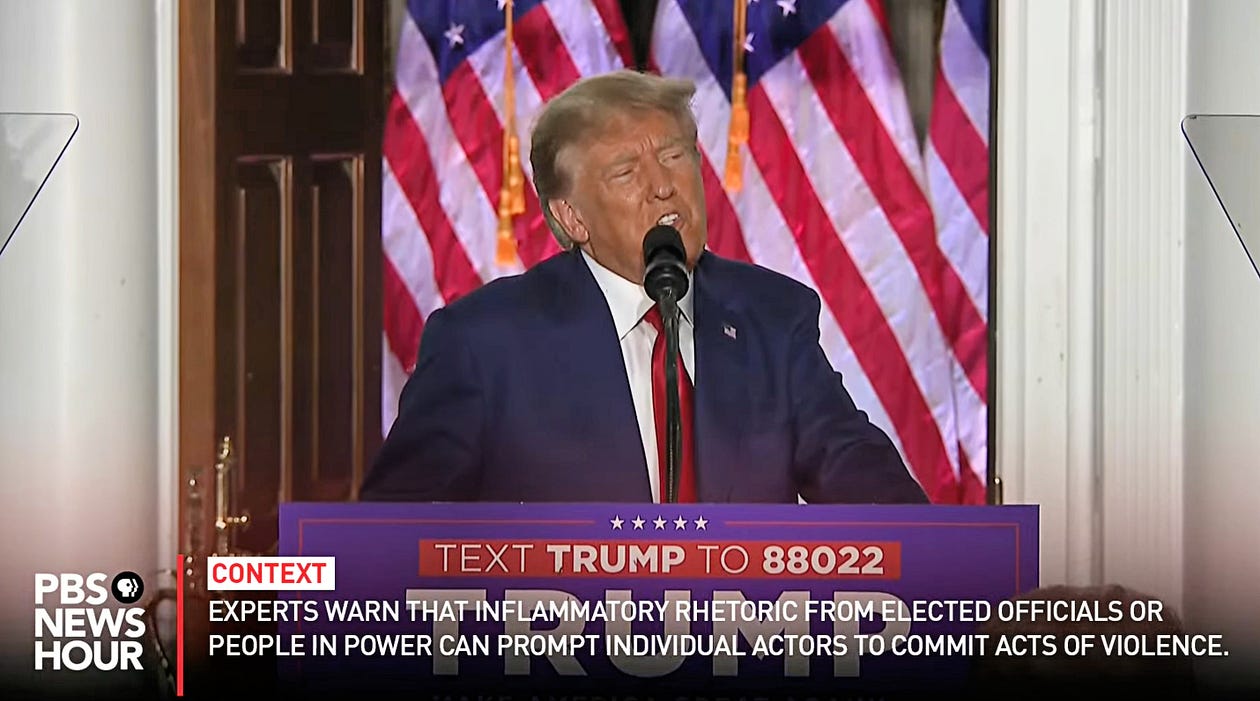
During its broadcast of Trump’s post-indictment rally on June 13, PBS NewsHour 
added factual context to the disgraced former president’s claims that he had won the 2020 election, that federal prosecutor Jack Smith was a “deranged lunatic” and a “thug,” and that the so-called deep state was “destroying our country” and “coming after you next.”

NewsHour
 set the record straight via text chyrons at the bottom of the screen. For example, when Trump falsely claimed that he had won the 2020 election, NewsHour layered on a chyron stating factually: “There is no evidence of widespread voter fraud during the 2020 election.”

How dare PBS.

But what really set off Trump loyalists was the 
NewsHour chyron that appeared near the end of the former president’s speech. As he pledged to use all his might to fight the deep state, NewsHour added a chyron stating: "Experts warn that inflammatory rhetoric from elected officials or people in power can prompt individual actors to commit acts of violence."

This triggered far-right influencers like Charlie Kirk (2.3 million Twitter followers) and Jack Posobiec (2.1 million Twitter followers), who took to social media to call for a total defunding of PBS.

By the following morning, “Defund PBS” was trending on Twitter and across other social-media platforms. 
The public-media network’s crime? Telling the truth.

Starving public media
But in their rush to discredit PBS, Kirk, Posobiec and their influencer ilk omitted some important details about U.S. public media. They forgot to mention that overwhelming majorities of people in the United States (81 percent) believe federal funding for PBS is taxpayer “money well spent,” according to a recent poll.

Americans also say 
they trust PBS twice as much as commercial broadcast TV, three times more than newspapers and five times more than cable channels.

Had these Trump supporters actually bothered to scrutinize the idea that the U.S. is overfunding public-media outlets, they would have found the opposite: U.S. government spending per capita on public media falls far below amounts offered by other advanced democracies. At $465 million, the U.S. FY 2022 allocation boils down to little more than $1.40 per person in the country.

By comparison, the United Kingdom spends $81 per person and France more than $75 per capita to support public media. Head further north and the numbers head north as well: Denmark spends more than $93 a person, while Finland spends more than $100 and Norway more than $110. And it isn’t just a European trend: Japan (+$53/capita) and South Korea (+$14) show their appreciation for publicly funded media at levels that put the U.S. outlay to shame.

“Despite being the wealthiest nation on the planet, the United States impoverishes its public media infrastructures,”
 writes Professor Victor Pickard, co-director of the Media, Inequality and Change Center at the University of Pennsylvania (and Free Press’ board chair).

And by impoverishing public media, the U.S. is also impoverishing democratic society.

recent comparative study by Pickard and Professor Timothy Neff found that more robust public-media funding deepened public knowledge about civic affairs and provided more diverse news coverage in a given country. After analyzing funding levels in 33 nations in Africa, Asia, Europe, Latin America, the Middle East, North America and South America, they concluded that “high levels of secure funding for public media systems and strong structural protections for the political and economic independence of those systems are consistently and positively correlated with healthy democracies.”

What ‘influencers’ don’t want you to know

And perhaps that’s what right-wing provocateurs don’t want you to know: Larger investments in public media help build the types of societies that are more resilient to authoritarian demagogues and the rampant spread of hate and disinformation.

In other words, what we really need to do is increase federal funding because such public support benefits democratic society as a whole.

Free Press has made increasing funds for public-interest media a 
central part of its mission since our founding more than 20 years ago. Not only have we fought efforts to defund NPR and PBS, we’ve also helped implement new ways to support local, independent and noncommercial media. This includes funding public structures to support the production of local and diverse news and information, and the sort of investigative reporting that holds abusive leaders accountable.

Our work in 
New Jersey and California has resulted in state-level solutions that prioritize outlets doing this important work. We are also calling for a tax on online advertising that would support an endowment for local-accountability journalism that would fund news-reporting efforts in communities that need them the most.

So the next time a cabal of far-right influencers shouts “Defund PBS” across social media, consider that these views aren’t broadly shared — and that such attacks are to be expected from followers of a disgraced and twice-indicted former president who believes a free press is the “enemy of the American people.”

When PBS added chyrons during Trump’s inflammatory speech, it was providing viewers with the fact that such rhetoric can lead to bloodshed. The Jan. 6 insurrection is just one prominent example of how the toxic lies of powerful people can fuel real-world violence. But it wasn’t the first example, and it won’t be the last.

What Kirk, Posobiec and their cronies are really afraid of is a public-media system that acts as a bulwark against such extremism, one that holds powerful people — like Trump — accountable for the lies they tell and the political violence that they knowingly incite.

How Musk’s Love of Hate and Disinformation Has Tanked Twitter’s Business

Twitter’s latest round of bad news recalls a meeting Free Press and other racial-justice and digital-rights groups held in early November, at the beginning of Elon Musk’s disastrous run as the platform’s CEO.

We 
sat down with the new-media boss to gauge his commitment to community standards, election integrity and content moderation. We urged Musk to retain and actually enforce existing content-moderation rules if he wanted advertisers to continue to spend money on Twitter — and not see their content appear alongside lies, bigotry and other extremist content.

He initially seemed to 
agree with us, but quickly reversed course, laying off many of those on the company’s trust and safety team in charge of this important work. Musk then granted a “general amnesty” to legions of neo-Nazis, conspiracy theorists and anti-vaccine trolls, reinstating thousands of previously banned accounts. He also gutted long-standing content-moderation rules and stopped enforcing Twitter’s ban on COVID-19 misinformation.

His purchase saddled the company with $13 billion in loans, and 
his refusal to seriously consider content moderation and brand safety ensured that Musk wouldn’t have the revenue he needed to pay off these debts.

Those who loaned Musk the money were banking on the “small chance that Elon is some sort of genius and can turn around an operational and financial situation that looks increasingly doomed,” 
financial writer William Cohan skeptically wrote at the time.

Musk’s erratic behavior since then has dashed those hopes.

Twitter’s toxic turn caused well over half of the company’s advertisers to leave by January of this year. And 
few seem intent on returning. A mistake-riddled attempt to recoup this lost revenue by selling Twitter Blue subscriptions hasn’t even won over one percent of the platform’s users, Bloomberg noted on Tuesday, adding that the company was now worth only a fraction of the $44-billion sum Musk paid for it.

In other words: Musk was wrong. We were right.

Amplifying hate, alienating advertisers
New research from the Center for Countering Digital Hate (CCDH) underscores this point: Allowing Twitter to become a hate-posting hellscape has imperiled any of the company’s remaining business prospects.

According to a CCDH sampling, Twitter has failed to remove 99 percent of hate speech posted by Twitter Blue users. Instead Musk has enabled algorithms that will amplify these and other paid accounts. To make matters worse, Musk’s own politics have become increasingly reactionary and strident, so much so that he has started to sound like many of the most vitriolic hate trolls featured in CCDH’s research.

Charlie Warzel of The Atlantic detailed Musk’s descent into the muck:
“[His] own rhetoric has moved from trolling to dog whistling to outright conspiracy peddling, and it has intensified in recent months, culminating in his recent anti-Semitic remarks about George Soros. A stroll through Musk’s replies on the site reveals the extent to which one of the richest men in the world spends his time replying to far-right influencers and nodding in approval to their racist memes.”
Musk rushed online to defend racist comic-strip author Scott Adams after he characterized Blacks in the United States as a “hate group.” He’s boosted “anti-woke” influencers and adopted much of their anti-trans and homophobic rhetoric, and recently amplified Black-on-white crime data in a way that is misleading and taken out of context.

When right-wing site Parler shut down in April, its bosses noted that their plans to create a Twitter clone for right-wing users were misguided, and the result was not viable as a business.

“If Musk weren’t too preoccupied [with] lapping up approval from trolls, reactionaries, and Dogecoin enthusiasts — a few of the constituencies left on his site that still seem to adore him — the Parler statement [w]ould worry him,” Warzel wrote.

The appointment of a new CEO with marketing expertise will likely do little to save Twitter. As my colleague 
Jessica J. González told CNN: “Musk is setting future CEO Linda Yaccarino up to fail — as long as he continues to make the platform toxic, it will be impossible to lure back advertisers and users.”

A CEO reshuffle won’t be enough — unless the new boss has the authority to reverse Musk’s many policy decisions and reinvest in content moderation and enforcement. So far, Musk hasn’t given any indication that he’ll allow someone else to fix his long string of screw-ups.

“Musk is ignoring a fundamental truth: to grow healthy and profitable online communities, you need effective content moderation,” 
I wrote in February. “If Twitter becomes insolvent — which seems more likely by the day — it’s because Musk lacks this basic business sense about social media.”

His decision to ignore this advice offered during his first week on the job set Twitter on a path to ruin that today seems inevitable.

Tuesday, May 16, 2023

CNN, Trump and the Media Mainstreaming of Demagogues


The pageantry of lies that passed for a town hall last week was yet another low point in CNN’s coverage of Donald Trump.
   To absolutely no one’s surprise, the former president used the media attention to paint an alternative view of recent U.S. history — one in which he features not as the twice-impeached, criminally indicted sexual abuser who lost the last presidential election, but as a decisive and winning strongman, the only person with the power and charisma to make America great again. It’s a script that appealed to his many MAGA supporters in the New Hampshire auditorium last week; they cheered on their man as he mocked the victim of his sexual battery and called CNN moderator Kaitlan Collins “nasty” for her often futile efforts to fact check Trump in real time. (Prior to the live town hall, a floor manager reportedly told audience members that they could cheer but not boo during the show.) And the Trump loyalists inside the town hall weren’t the only ones cheering on cue. The day after the program aired, CNN CEO Chris Licht praised the event, telling staff that “America was served very well by what we did.” Really? That trainwreck was a public service? Licht’s self-flattery echoed comments other media execs have made when defending their network’s decision to amplify all things Trump. In 2016, then-CBS CEO Les Moonves offered a more accurate view: Devoting so much airtime to then-candidate Trump “may not be good for America, but it’s damn good for CBS,” he said, referring to the bumper crop of political ad dollars brought in during the contentious 2016 election. Trump’s media makeover At least Moonves was being honest. The media’s Trump binge harmed the nation but helped their bottom lines. Licht, on the other hand, is trying to convince everyone that democracy itself benefits when the media give Trump a megaphone. Licht likely learned that from his predecessor at CNN. Jeff Zucker has arguably done more than any single person to burnish the 21st-century caricature of Donald Trump. While an executive at NBC, he greenlit The Apprentice, which remade Trump from a bankruptcy-spawning loser into a boardroom genius with impeccable business savvy.   When Trump entered the political arena in 2015, he did so with an Apprentice tailwind. Zucker, who by then had transitioned to the top job at CNN, trained the network’s cameras on his celebrity candidate while denying equal time to Trump’s Republican opponents.  Early in the 2016 campaign, The New York Times estimated that the major networks had already given Trump the equivalent of $2 billion in free advertising — with much, much more to come by election day. The media chose Trump well before most Republican voters had a chance to vote for any of the other GOP candidates in the race. Mainstreaming fascism All of this is to say that last week’s town-hall debacle is just more evidence of the dangers inherent in a commercial media system that mainstreams lying demagogues for profit.   Absolute disregard for the facts and mythologizing of strongmen are pre-conditions for fascism, say historians Fred Turner and Ruth Ben-Ghiat.  Turner, who teaches at Stanford, has written about the parallels between Donald Trump’s leadership style and that of Benito Mussolini’s early rule in 1920s Italy. The difference, according to Turner, is that we now live in a virtual world where people can surround themselves with a “fake news” media sphere all their own.  “The real problem is actually more of a structural problem,” he told an interviewer in 2016. “Media firms in lots of different subsets need to make money on advertising. When you are dependent on advertising, controversy is good,” he said. “It doesn’t matter whether it’s true or not. What matters is that it gets a lot of attention.” Like Mussolini, Trump is a master at manipulating media attention to amplify his propaganda, says Ben-Ghiat, a NYU professor who has studied authoritarian patterns worldwide. Many in the U.S. media have been “slow to catch on to what Trump [is] doing,” she said Or perhaps news outlets don’t care. As long as Trump’s hijacking of media attention makes them richer, why should media execs worry about the consequences?    CNN has faced a storm of criticism for its decision to give Trump a primetime slot, and deservedly so. But the network’s choices are symptoms of a larger problem. The commercial U.S. media system needs to undergo deep reckoning for its role in accommodating the rise of camera-friendly authoritarians. Without this serious assessment of the failings of top news execs like Zucker, Moonves and Licht, the media will never quit its Trump habit.   As an antidote we also need to support a noncommercial public-interest media system that promotes democracy and civic information. This includes funding public structures to support the production of local and diverse news and information, and the sort of investigative reporting that holds abusive leaders accountable.  While this approach doesn’t pretend to address every threat facing democracies today, it recognizes that a more robust noncommercial media can serve as a bulwark against the democracy-destabilizing forces of 21st-century demagogues. And it can do so in ways that prominent commercial outlets like CNN have failed to.


Wednesday, May 03, 2023

How Lawmakers and Regulators Are Helping Sinclair Destroy Local News

Sometimes lawmakers write legislation that would do the opposite of its stated goal. Nowhere is this more evident than in two recent bills — one introduced at the state level and another in the U.S. Congress — that are supposedly designed to “save local news.”  Both the California Journalism Preservation Act (CJPA) and the federal Journalism Competition and Preservation Act (JCPA) would allow news publishers — including broadcast companies — to extract payments from large social-media enterprises like Alphabet and Meta in exchange for linking to their content. This would apply to any content regardless of its accuracy or news value. One of the bigger beneficiaries of California’s CJPA and the U.S. Senate’s JCPA is a conglomerate that seems determined to get rid of local news and replace it with right-wing spin produced at a “National Desk” far removed from the communities this broadcast company is legally obligated to serve. That conglomerate, Sinclair Broadcast Group, recently announced plans to eliminate entire local newsrooms at local-television stations in five broadcast areas. Sinclair is also drastically cutting newsroom staff at an additional five local stations, pushing all of these stations to fill the resulting news hole with National Desk boilerplate. That means zero local coverage — and lots of the sort of cookie-cutter conservatism that Sinclair has pumped out via the public airwaves for decades. Saving local news by throttling it Sinclair doesn’t care about the benefits that local-news coverage brings to communities. The company owns and operates several stations that broadcast to regions of California, including KAEF in Eureka, KBAK in Bakersfield, KMPH in Fresno, KRCR in Redding and KRXI around Lake Tahoe. Any of these newsrooms could be next on its chopping block. But lawmakers in Sacramento and Washington are ignoring Sinclair’s dismal track record and moving forward with legislation that would reward Sinclair as it undermines local news. On Tuesday, the CJPA passed through California Assembly’s Judiciary Committee just a few days after the Committee on Privacy and Consumer Protection advanced it. And in Washington, Sen. Amy Klobuchar has reintroduced the JCPA, which failed to pass in the previous Congress after facing headwinds from a coalition of local-news advocates and media-democracy groups.  Both bills would create a convoluted mechanism for corporate handouts to highly profitable and consolidated media outlets — and both bills would allow these chains to continue to neglect the information needs of the communities they’re supposed to serve. That these bills have any momentum is largely due to the powerful Big Media lobby pushing them. This includes lobbyists working on behalf of Sinclair as well as Gannett Co. and predatory hedge fund Alden Global Capital, which have also cut local newsrooms to the bone even as they’ve continued to buy back stocks, go deeper into debt to acquire more local outlets, and use other financial gimmicks to enrich their owners, executives and shareholders.  These companies aren’t journalism’s saviors. In many places they’ve created news deserts after shuttering local operations. Lawmakers shouldn’t reward them for such slash-and-burn tactics. Instead, policymakers should pass bills that support local-accountability journalism by putting reporters back on local beats and expanding coverage in communities that companies like Sinclair have neglected. The FCC must step up, too The Federal Communications Commission has done next to nothing to discipline these companies for their misuse of the public airwaves. 
An FCC mandate is to “protect and advance diversity, competition and localism in the media marketplace.” The agency has instead allowed Sinclair to consolidate control over nearly 200 local stations. And in 2018, the conglomerate misled the FCC about the nature of its control over the many stations it already owned in a failed attempt to gobble up even more. In exchange for exclusive access to so much of our public airwaves, Sinclair thumbs its nose at public-interest obligations, delivering the bare minimum required by the FCC. It created sham businesses and shell companies to evade FCC station-ownership limits. It forces these local-TV stations to air “must-run segments” filled with propaganda seemingly pulled straight from a MAGA rally. And it routinely cuts back on local-news staffing while its top executives get rich off the bumper crop of political campaign ads that come around every two years. Whether it’s via state or federal legislation, or a federal agency that has too often bucked its obligation to serve the public interest, regulators seem intent on saving local news by ignoring — or even perpetuating — the problems that led to its collapse in the first place.  Once we recognize the miscues and market failures driving the journalism crisis, it becomes hard to justify simply handing money over to these same incumbents. This recognition requires we shift our focus away from bills like the CJPA and JCPA toward public policy that creates funding for local-accountability journalism, including noncommercial initiatives.  The FCC needs to take a long-overdue look at its legacy of failure. Promoting competition, localism and diversity means giving more locally owned outlets access to the public airwaves — outlets that will serve their communities in ways Sinclair has not.  In a strategic sleight of hand, the large news-media companies want us to conflate the public importance of local journalism with their own bottom lines. When companies like Sinclair lobby for these bad bills, they want us to forget their actual record of mistreating their own reporters. They want to pretend they’re not getting rich by maintaining this broken system that’s misusing our airwaves and poisoning our democracy. The problem is that too many of our elected representatives and appointed media regulators are all too willing to give Sinclair a pass, and have opted to “save local news” by becoming accessories to its demise.